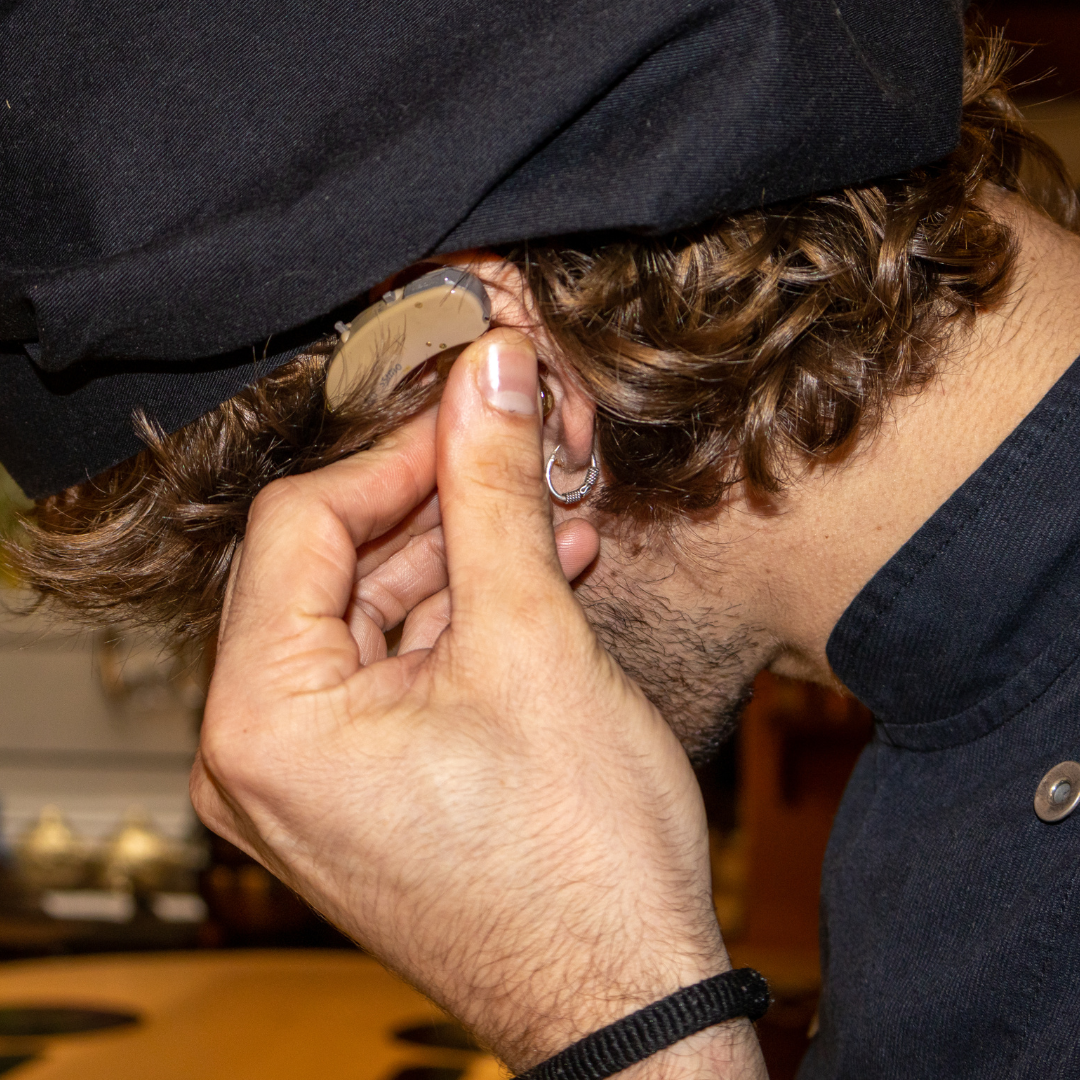
Group discussions in restaurants often become difficult to comprehend when room acoustics compete with your focus and hearing. Our clinical team can evaluate hearing across quiet settings and background-noise environments to pinpoint specific auditory challenges. Once the diagnostic etiology of your difficult hearing is established, we implement personalized clinical and technological strategies.
Why Do I Hear Well in Quiet but Struggle in Restaurants?
Calm domestic settings establish a positive signal-to-noise ratio, allowing target speech to stand out clearly from faint background noises. Modern restaurant environments create the complete opposite listening environment. Multiple voices, music, kitchen noise, and reverberation overlap with speech, forcing the ears and brain to work harder to separate the person you want to hear.
This symptom pattern often reflects underlying high-frequency hearing loss, central processing dysfunction, or physiological aging of the auditory nerve. Factors including listening fatigue, poor dining lighting, acoustic distance, and wandering attention make comprehension significantly harder. Numerous individuals show standard hearing thresholds on paper but reveal marked comprehension drops on clinical speech-in-noise testing. Difficulty in restaurants deserves evaluation even when everyday hearing seems normal.
The Audiological Process for High-Frequency Hearing Loss
We begin with a history of the situations that cause trouble, along with questions about noise exposure, tinnitus, medications, family history, and changes in either ear.
Standard pure-tone audiometry gauges the lowest volume thresholds detectable across varying acoustic frequencies via specialized earphones and bone oscillators. High-frequency hearing loss commonly presents on the audiogram as a characteristic precipitous drop in the higher frequency ranges. Diagnostic evaluations may also integrate acoustic tympanometry to check middle-ear pressure alongside word-recognition testing to evaluate speech processing.
Because a quiet booth does not recreate a busy dining room, speech-in-noise testing can add valuable information. This procedure gauges speech-discrimination accuracy while competing multi-source noise becomes incrementally louder. Interpreted together, these clinical scores demonstrate whether listening struggles originate from loss of audibility, speech clarity deficits, auditory processing delays, or combined elements.
How Do Auditory Processing Disorders Affect Hearing in Adults?
An auditory processing disorder affects how the central auditory nervous system interprets sound. Even when the ears detect individual frequencies accurately, the central auditory system may falter at sorting overlapping voices, distinguishing close speech sounds, or processing fast-paced dialogue. We first evaluate peripheral hearing and then determine whether an individualized auditory-processing test battery or referrals to other professionals are appropriate.
Practical Strategies for Improving Speech Understanding in Noise
Minor environmental adjustments can boost speech acoustic signals and supply critical visual lip-reading cues. Prior to dining, choose venues known for lower noise levels or schedule meals during quieter dining hours. Facilities equipped with upholstered booths, acoustic baffles, fabric curtains, carpeted floors, and soft materials prove far easier on hearing than minimalist, hard-tiled spaces.
While seated at the restaurant:
- Request a table away from the kitchen, bar, speakers, and large groups.
- Sit with a perimeter wall directly behind you to cut down on ambient noise approaching from the rear.
- Seat yourself facing conversation partners under clear, bright lighting to facilitate visual speechreading.
- Reduce physical spacing between yourself and companions to maximize direct speech perception.
- Orient your stronger ear toward the key person you want to follow in conversation.
- Ask speakers to reword the specific phrase you missed rather than repeating their initial wording.
- Validate significant pieces of information directly rather than feigning understanding during dialogue.
- Step away for a brief auditory rest when cognitive listening fatigue begins to set in.
- Ask dinner guests to speak with clear enunciation at a steady, natural conversational rate.
- Shouting creates acoustic distortion that actively compromises speech understanding rather than helping.
Assistive Hearing Tools and Technology for Complex Acoustic Environments
Choosing the most effective auditory device requires evaluating diagnostic findings, acoustic lifestyle factors, and the presence of hearing loss. Customized hearing aids employ directional microphone beamforming, noise cancellation algorithms, and targeted dining programs to prioritize speakers in front while lowering ambient noise. Maintaining realistic expectations remains essential, as no auditory device can isolate conversation by removing all surrounding voices.
Remote wireless microphones offer an exceptional boost to the signal-to-noise ratio in challenging venues. The remote unit is attached to the speaker’s clothing or placed nearby, transmitting that voice straight into compatible hearing aids or an audio receiver. By streaming directly, this technology overcomes acoustic falloff from distance and surrounding environmental noise.
Other clinically valuable tools include:
- Dedicated table microphones engineered to capture small-group dialogue
- Built-in telecoils linking directly with induction hearing-loop systems in public venues
- Real-time smartphone speech-to-text transcription and live-captioning apps
- Consumer wireless earbuds or hearables featuring customizable assistive listening modes
- Sound-level or restaurant-review tools for finding quieter locations
We analyze suitable devices, verify functional compatibility with your current setup, and guide you through real-world operation.
How an Audiologist or Physician Can Improve Hearing in Noise
A comprehensive hearing evaluation looks far beyond the common misconception of “I hear fine in quiet environments.” Our clinicians review the specific environments, vocal pitches, and decibel levels that trigger breakdowns to design a personalized test protocol. Testing routinely combines pure-tone audiometry, middle-ear impedance tests, speech discrimination, and speech-in-noise measures. Advanced auditory-processing testing can be introduced whenever medical history and baseline assessments justify specialized evaluation.
Hearing changes that present abruptly, affect only one side, or progress rapidly necessitate consultation with an ear, nose, and throat physician. Individualized diagnostic care pinpoints the precise physiological etiology rather than merely blaming restaurant noise for communication struggles.
Contact Us for a Hearing Evaluation Today
If crowded restaurant settings cause you to feel disconnected, tired, or forced to guess at conversations, arrange a diagnostic hearing evaluation today. Our specialists can introduce effective interventions to support your hearing in noisy environments via precision hearing aid fittings, assistive devices, or audiological rehabilitation.
Contact our audiology office today to schedule your evaluation and move toward effortless, confident conversations.